Building a Company Brain Before Building AI Agents
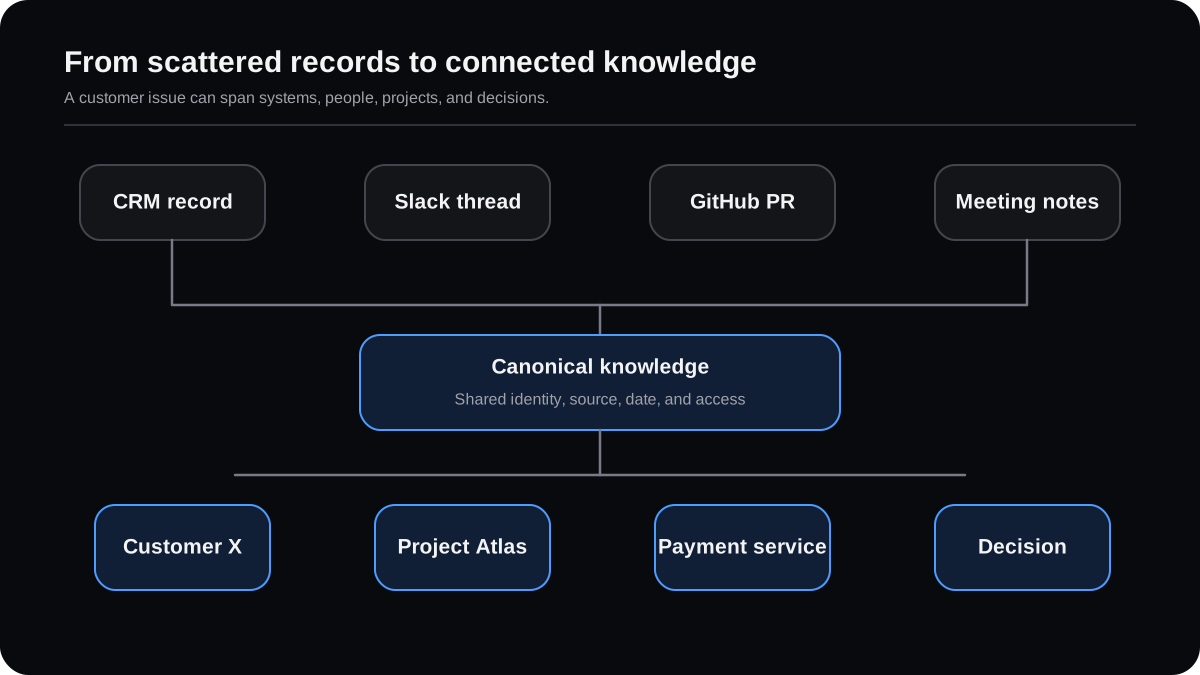
I began with a simple question while working on AI systems for companies: how can an agent do useful work if it does not understand where the company’s knowledge lives, who may access it, or how its systems connect? I wanted a shared knowledge layer that comes before agents and automations, so each one can start with context instead of learning the business from scratch.
In one project with a company I will call X, the problem was not missing information. The company knew a great deal. Its knowledge had accumulated across Google Drive, Slack, CRM, project tools, GitHub, databases, spreadsheets, and internal systems. Ask sales about a customer and you get one part of the story. Ask operations and you get another. A decision might live in a Slack thread, its technical reasoning in GitHub, and its current status in a project tool.
That is normal. It is how real companies work.
The question was what happens when AI needs to work inside that environment. If I build a sales agent, an operations agent, a project automation, and a model that answers employees’ questions, should I explain the company separately to each of them? And what happens when the business changes?
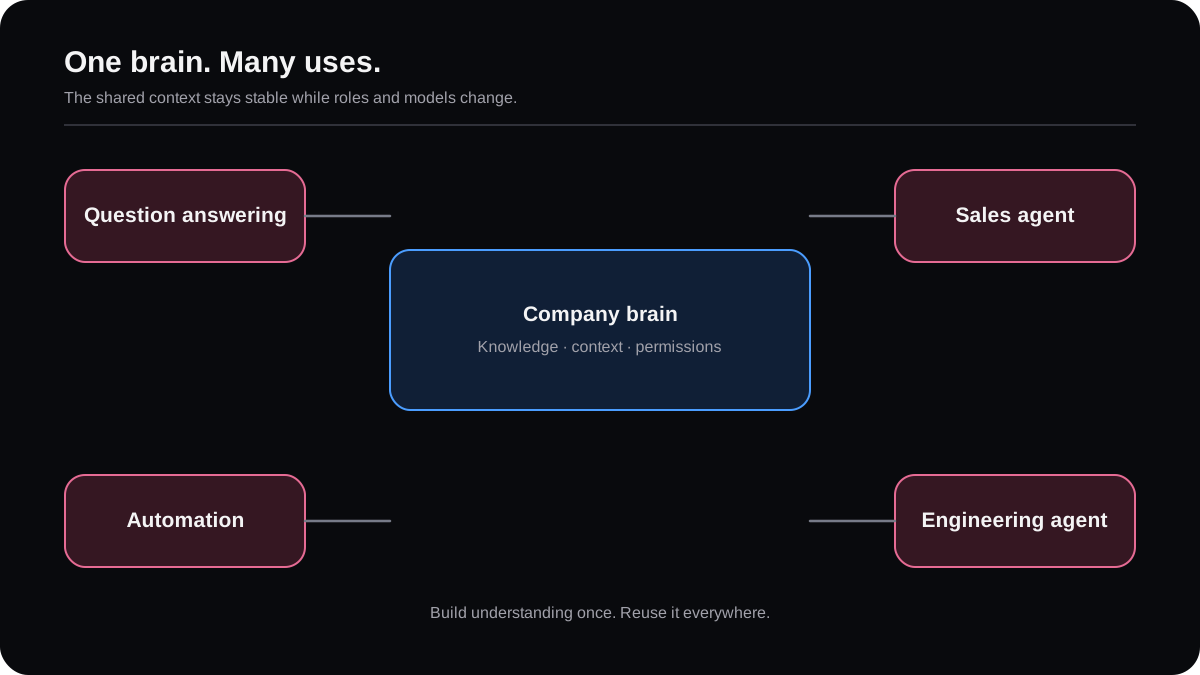
My answer was to build the company’s understanding first. A model, an agent, or an automation can then work on top of it. This “brain” is more than another file search box: it connects knowledge, systems, relationships, and permissions so AI can understand the situation before it answers or acts.
I Did Not Want to Move the Company Into a New System
The obvious knowledge-base idea is to collect everything in one place. In real companies, that is rarely practical. Sales lives in the CRM, engineers live near code in GitHub, decisions happen in Slack, documents live in Drive or Notion, and finance and operations rely on their own systems.
So I took the opposite direction. The knowledge layer should reach information where it already lives. Slack stays Slack, GitHub stays GitHub, CRM stays CRM, but AI can start seeing them as connected parts of one company.
I Quickly Learned That a Vector Database Is Not a Knowledge Base
A basic RAG prototype can chunk documents, create embeddings, store them in a vector database, and send relevant chunks to a model. That is useful, but it is not enough for a living company.
The hard questions came quickly: Which version of a contract is current? Is Project Atlas in Slack the same project in the project-management system? What if the answer is a number in a database? What if the user is not allowed to see the result?
Vector search became one layer in a larger brain: original data, canonical knowledge, metadata, search indexes, a knowledge graph, permissions, versions, and change history.
A vector database can retrieve semantically similar text, but it does not decide whether a contract is current, whether two names refer to the same project, or whether a user is permitted to see a result. Those questions require structure around the embeddings. I did not add the other layers to make an impressive architecture diagram. Each one emerged because the previous layer could not answer a real question.
The Knowledge Layer Needed a Shared Language
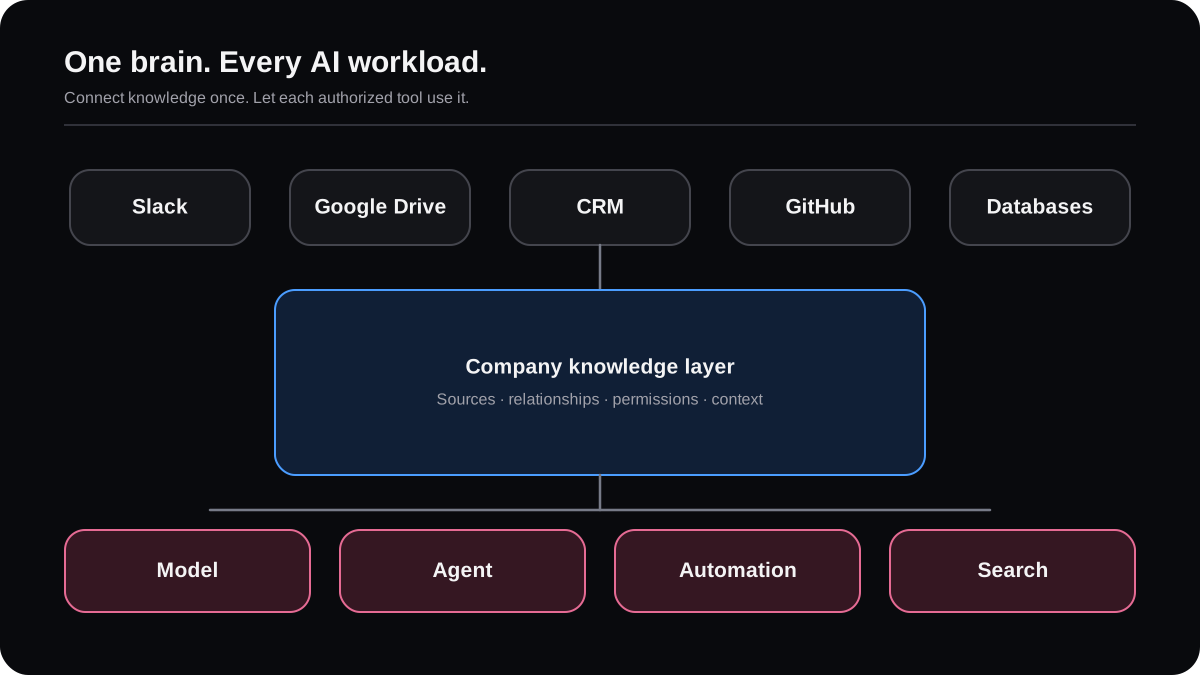
A Slack thread, a CRM record, a project-management task, and a GitHub pull request can all describe the same customer issue. Each source has its own shape, but to the company brain they are parts of one story.
That is why I designed a canonical knowledge layer. Connectors understand their source systems, then normalize content, source, type, date, related projects or customers, people, access rules, and relationships so every approved model or agent can use the knowledge consistently.
Information Alone Was Not Enough
The real value often appears in relationships. A client may connect to a project, a team, a decision, a code change, a later Slack incident, and the engineers who handled it.
A knowledge graph helps the brain understand how company knowledge connects. Some relationships come directly from systems. Others are inferred by AI from content, with confidence and source preserved.
Some relationships are explicit. The CRM can say who owns a customer account, and a project tool can say which project owns a task. Others are only visible across conversations, documents, meetings, and code. I let AI propose those links while keeping their source and confidence, rather than pretending every inferred connection is a fact. The graph must be able to change as the company changes.
Vector Search Was Strong, But It Saw Only Part of the Picture
Semantic search is excellent when the user uses different words from the source. But exact identifiers, error codes, dates, project scope, recency, permissions, and structured data require other retrieval methods.
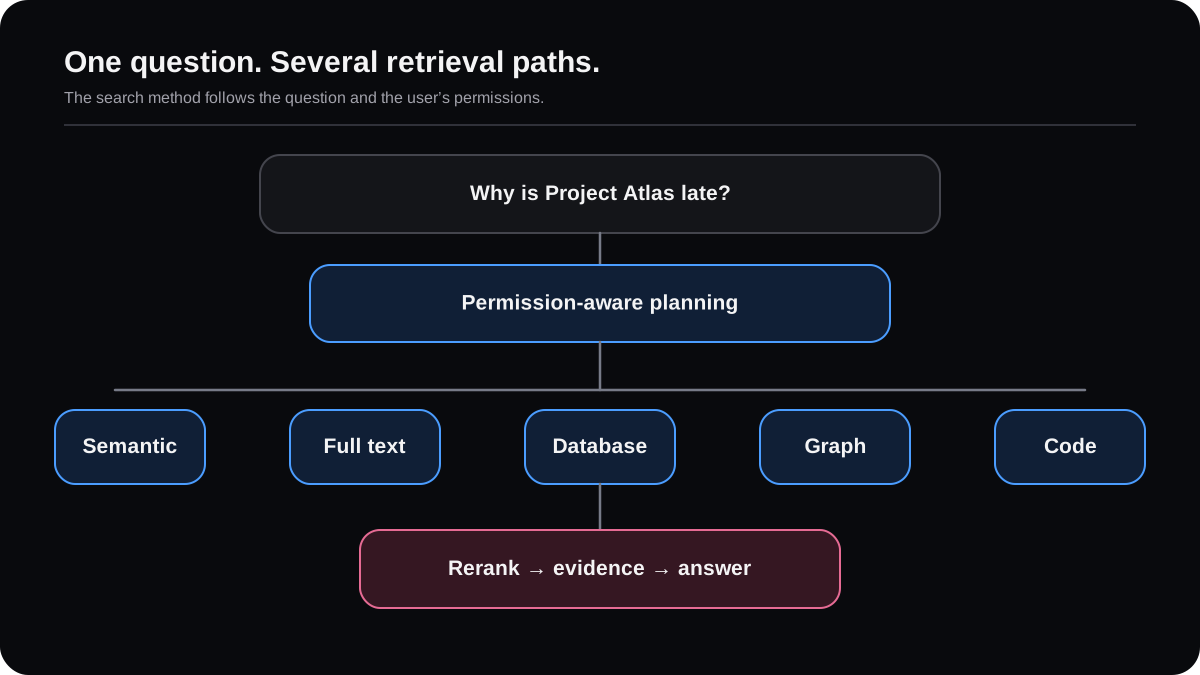
The layer uses hybrid retrieval: semantic search, full-text search, metadata filters, structured queries, recency, and graph relationships. The brain should not ask every question the same way; it should choose the method that fits the question.
Slack Was One of the Hardest Places to Understand
Documents have titles, sections, and stable context. Slack is different. A thread may begin with “the issue came back,” include logs, explore several theories, and end with one person explaining the real fix.
Treating every message as a separate knowledge chunk loses context. Treating the full thread as one embedding can bury the important signal. A thread might start with “the issue is back,” move through logs and several wrong guesses, and only twenty messages later reveal that an API gateway timeout caused the failure. I keep the original conversation and extract the issue, systems, root cause, final resolution, participants, and related entities.
Summaries Alone Lose Important Details
A summary helps, but one small message inside a long thread may contain the exact configuration value an engineer needs months later. If the whole conversation has just one summary, that detail can disappear.
I therefore keep multiple views of the same conversation: a summary, the central question, the final answer, named entities, important groups of messages, and the original text. Consecutive messages from one person may also need to stay together, especially when they write one thought across several short messages. The useful question is not “what is the ideal chunk size?” but “how might someone need to find this later?”
Not Everything Said Inside a Company Should Become Knowledge
A message like “done, thanks” does not have the same value as a message explaining the root cause of a production issue. I would not create an embedding for every message just because I can.
I look for signals such as rare terms, error codes, code snippets, final resolutions, substantial explanations, and team engagement. Even a measure such as inverse document frequency can help distinguish specific language from words repeated everywhere. Retrieval quality starts while the knowledge is being built, long before a user asks anything. If the index fills with low-value content, later retrieval has to repair a problem that should have been prevented earlier.
The Brain Must Move With the Company
The best answer based on outdated information is still a bad answer. The company brain is not a one-time import; it has to follow changes in the source systems.
In Slack, new events can arrive through a connection such as Socket Mode. A reply to an existing thread can update its representation instead of becoming an isolated fact. When documents change, CRM records move, or code is revised, the affected knowledge, metadata, relationships, and indexes must change with them. The brain is not an archive of the company. It is a living picture of it.
Structured Data Should Stay Structured
Not everything should be converted into text for embeddings. If a manager asks how many contracts expire this month, the answer belongs in structured data, not paragraphs derived from table rows.
The brain understands different knowledge types and routes questions accordingly: SQL, CRM search, vector search, full text, or graph traversal.
Before Searching, the Brain Must Know Where to Search
Running every retrieval method across every source for every question is expensive and noisy. A contract-renewal question should not search GitHub. An authentication architecture question may need Slack, GitHub, docs, and meeting notes.
I plan lightly before retrieval, using the user identity, permissions, project context, available sources, and the nature of the question to choose where and how to search.
Finding Results Is Easier Than Choosing the Best Ones
After retrieval, many results may appear across sources. The first vector result is not always the best evidence.
One useful method for merging search paths is reciprocal rank fusion: compare where a result ranks within each method rather than treating scores from different systems as interchangeable. I then remove duplicates and rerank the strongest candidates against the actual question.
I want the best evidence, not the largest pile of context. Cleaner context usually means a better answer, fewer tokens, lower cost, and less delay.
Sometimes the Right Fact Needs Its Surrounding Context
Chunking helps retrieval, but it can separate a sentence from the heading, thread, class, or neighboring section that makes it true.
After reranking, the brain can expand context: nearby document sections, surrounding Slack messages, or the file around a function. Finding the right sentence is one thing. Understanding it correctly is another.
What an Employee Cannot See, AI Should Not See
Permissions were not an afterthought. If an employee cannot open a finance folder in Google Drive, they should not access it through an agent by asking differently.
Every knowledge item carries access information, and permissions shape retrieval itself. I should not search everything and hide forbidden passages just before displaying an answer. Two employees can ask the same question and receive different answers because each can see a different part of the company.
Agents need action permissions as well as reading permissions: access to CRM data does not automatically allow a CRM update, and an operations automation must not inherit access to finance.
As the Company Grows, Scope Becomes More Important
Searching everything sounds useful at first. As data grows, it creates noise. Finance does not need engineering repositories for invoice questions, and an engineer working on one service does not need sales presentations in every search.
I organize knowledge by workspaces, departments, projects, and shared sources so retrieval can narrow scope before search.
Sometimes the Best Answer Is a Person, Not a Document
A mature knowledge graph can identify expertise inside the company. The best answer to “who understands this system?” may be a person who joined the relevant threads, reviewed pull requests, wrote documentation, and attended meetings about the issue.
Not all company knowledge is written. Sometimes the most useful thing the system can tell you is who to talk to.
The Difference Between a Knowledge Base and a Company Brain
If I had stopped at search, I would have built enterprise search. The company brain is more than that. It supports answers, agents, and automations before action is taken.
A request like “prepare me for tomorrow’s meeting with X” may need CRM status, recent messages, past meetings, open issues, project status, overdue invoices, and support tickets. The brain provides context; the agent uses it to complete the task.
I Do Not Want Every Agent to Learn the Company From Scratch
Without a shared brain, every new agent repeats the same setup: tools, files, project names, people, permissions, and rules.
With a shared knowledge layer, a new agent enters a company that is already understood. What changes is the agent role: what it can do, what tools it can use, what it can see, and what actions it may take.
The Model Is Not the Company Memory
The company brain was never designed around one model. A user may use OpenAI for one task, Anthropic for another, and a local model for sensitive work.
Company knowledge should not change when the model changes. The brain owns context; the model uses the context it needs.
Even With All This, the Experience Must Stay Simple
Behind one question, the brain may plan retrieval, call sources, merge results, apply permissions, check freshness, rerank evidence, expand context, and send clean context to a model.
The user should not have to see that complexity. They should ask a clear question and receive a clear answer with sources.
A person should be able to ask, “Why is Project Atlas late?” and get an answer with its sources. The answer may combine project status, a Slack decision, meeting notes, and a GitHub pull request. The system should carry that complexity so the person does not have to.
What Changed for the Company?
Before the brain, good AI use depended on the person knowing where the files were, which channel mattered, who owned the project, and what to put in the prompt. New employees and new agents lacked that context.
After the brain, there was a shared knowledge layer that understood sources, relationships, and permissions. The company itself became the context.
I Did Not Want the Project to Become a Year-Long Data Migration
Real companies are messy: old files, renamed projects, confusing folders, long conversations, and systems built by different teams over years. The company brain has to work with that reality.
It starts from existing data, connects sources, builds canonical knowledge, extracts relationships, applies permissions, creates indexes, and improves over time. It is not a snapshot taken during setup; it lives with the company.
What Am I Really Building?
Running a model, building an agent, connecting an API, and executing automation have all become easier. The harder question remains: what does AI know about the company before it starts working?
Does it know customers, projects, previous decisions, freshness, system relationships, people, permissions, and how to access all of this without being retaught the company every time?
That is why the brain is the foundation of the system. I do not want to give companies a new AI tool for every problem. I want to build one brain that understands them, then let AI work on top of that understanding.